SprayFoam IT Become a sponsor
In developmentLooking for sponsors and supporters

Practise before it costs a job.

A VR spray foam training platform built on a physics-based foam model: real chemistry, a modelled rig, and a score card that tells you what went wrong, in plain language.
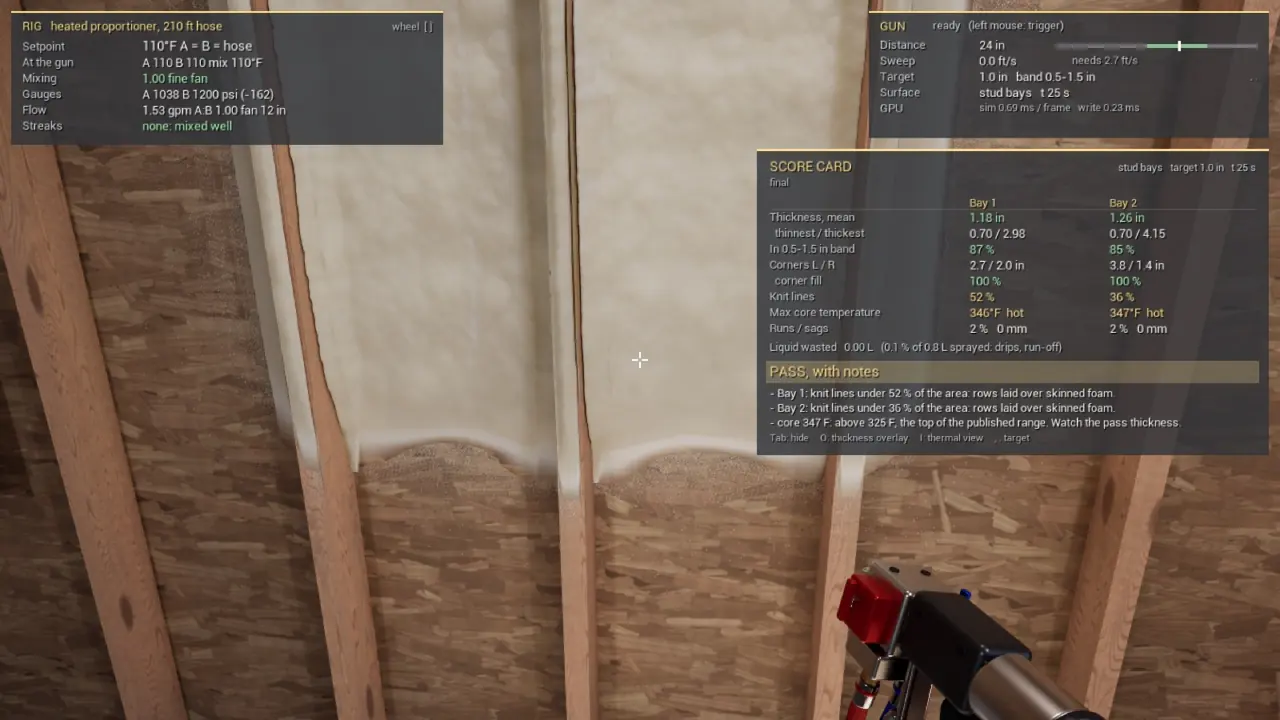
Real-time simulation captureDevelopment build
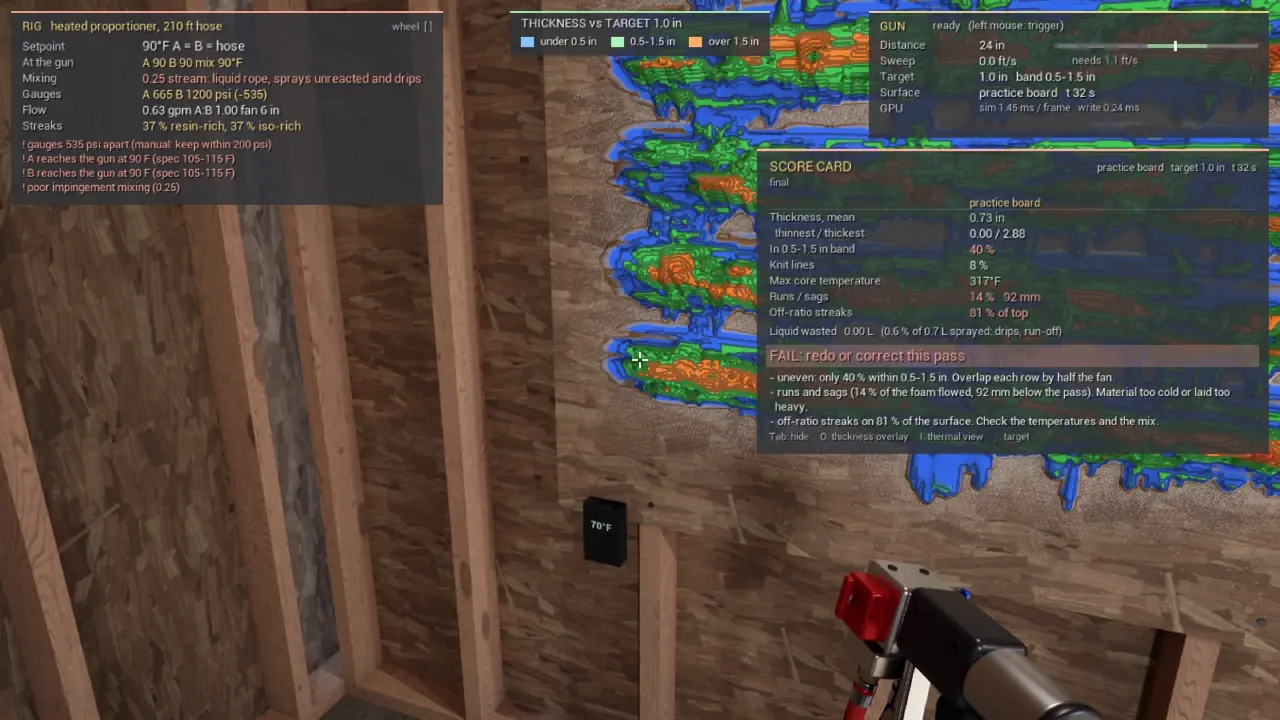
A pass in the simulator: the rig readout (top left), the gun, and the score card after the pass.
A pass in the simulator: the rig readout, the gun, and the score card after the pass.
01

Real chemistry, not an animation

Foam rise, cure, runs and shrinkage come from a reaction model, not a canned effect.

02

Your rig is part of the lesson

Heated proportioner, a long heated hose and whip, setpoint, gun, mix chamber.

03

Every pass is scored

Thickness, corners, knit lines, core temperature, runs, off-ratio streaks, liquid wasted.

04

Mistakes are cheap here

A bad pass costs a minute in the headset, not a customer's wall.

// The problem

The problem it targets

Spray foam mistakes are expensive and visible: off-ratio foam, cold chemicals, cold substrates, passes laid too thick, runs and sags, knit lines, scorched cores. Crews usually learn them on a customer's job.

SprayFoam IT lets an applicator make each of those mistakes in the headset, see exactly what it did to the foam, and fix it, before it costs a job.

Failure modes the simulator reproduces today

Scenario

Off-ratio streaks

Resin-rich or iso-rich pockets.

Scenario

Cold chemicals and cold substrate

Scenario

Too-thick passes and hot cores

Scorch and charring risk.

Scenario

Runs and sags on a wall

Scenario

Knit lines between passes

Scenario

Drips from a ceiling

Scenario

Thin corners

Versus full picture-frame fillets.

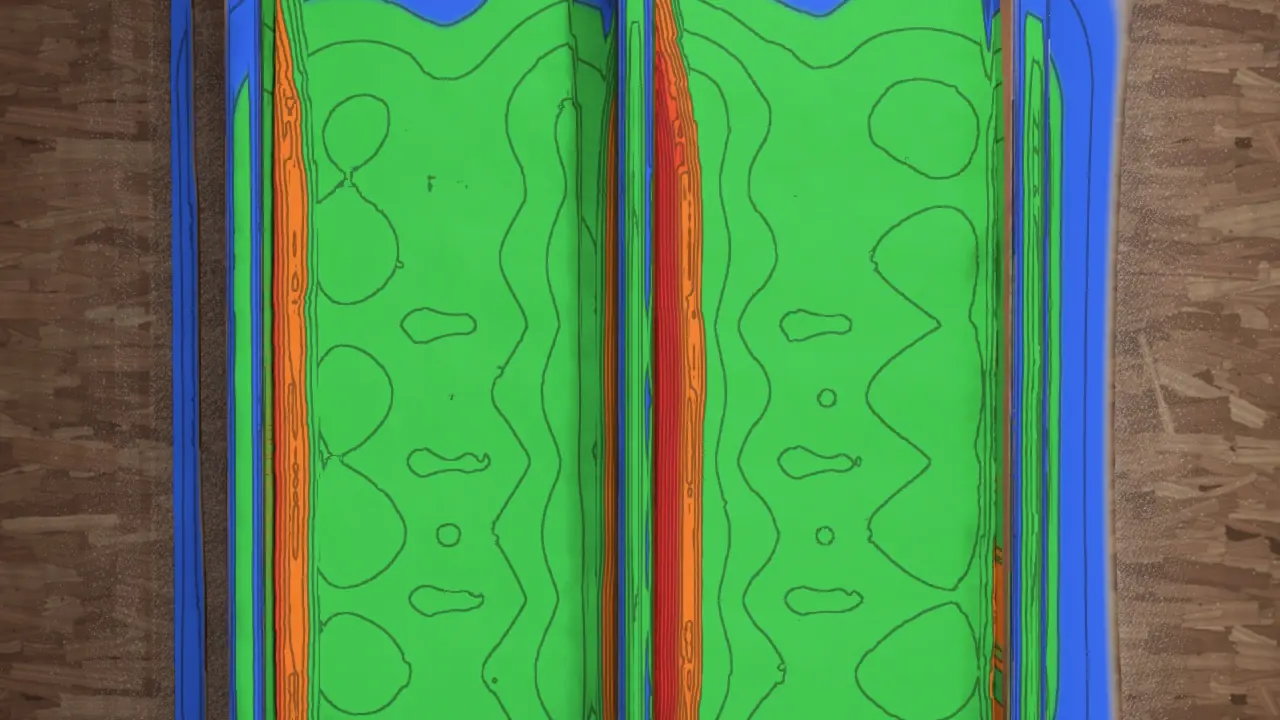
Overlay on a cold-substrate pass. Real-time simulation capture.
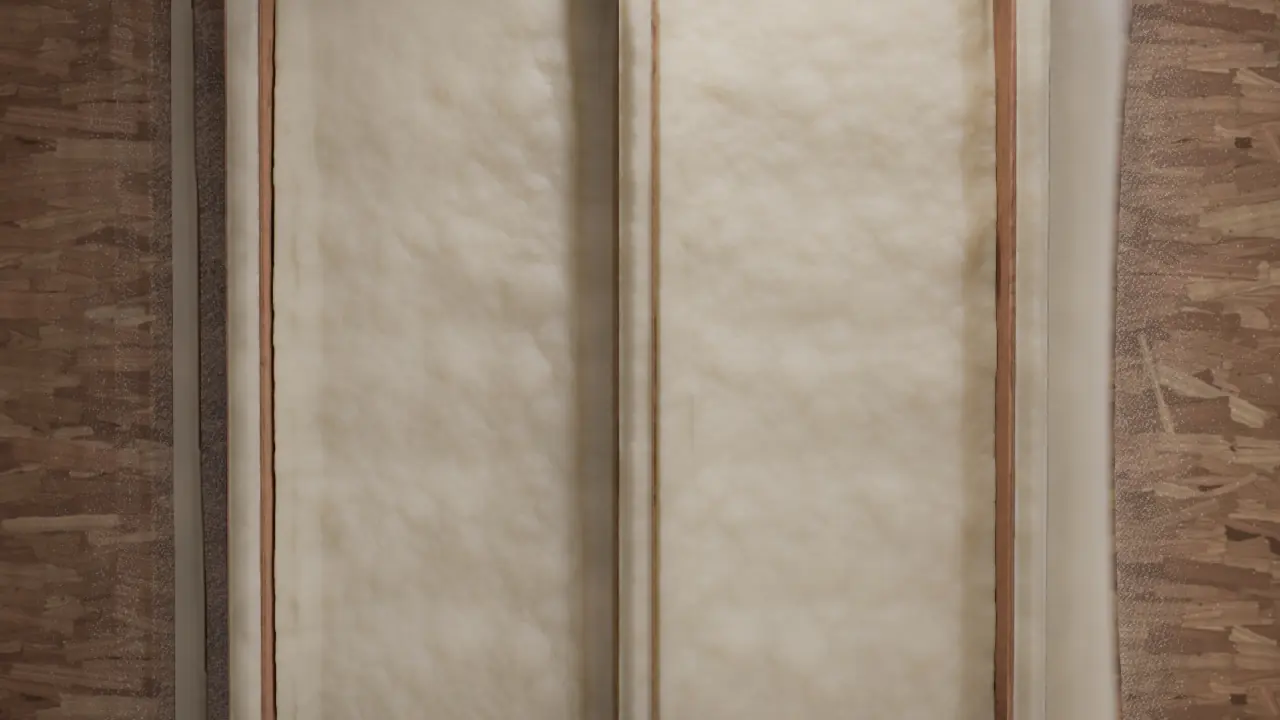
Two stud bays after the pass. Real-time simulation capture.
// The simulation

A foam model built from the drum up.

Inputs are described the way a chemist would describe the drums: the isocyanate's NCO content and functionality mix, the polyol's OH numbers and functionalities, water, blowing agent and flame retardant, and the A:B ratio. The model works out gel point, network, rise and cure from those.

It models the reactions separately: gelling (urethane), blowing (water to urea and CO2) and side reactions from excess isocyanate; heat of reaction; and the blowing agent evaporating, dissolving and condensing back in cold cells.

Bubbles grow and compete (a bubble-population model); viscosity changes with temperature and cure, which is what makes foam run on a wall; the gelled network stops the rise; cells can rupture or open; the cured foam can shrink.

It reports the numbers an installer cares about: cream, gel, tack-free and rise times, density, cell structure, shrinkage over seven days, runs on a wall, soft or brittle foam, and core temperature.

A model run takes 1 to 3 seconds. The live simulator runs a fast version of the model on the GPU, in real time as you spray: a precomputed chemistry table plus a GPU spray-and-flow simulation. It matches the lab's own reference simulation to within 0.01 percent of a pass thickness in every test scenario, and 25 of 25 regression checks come out byte-identical from one game version to the next, so a change never silently alters the foam. The live simulator's chemistry table is computed from the version-3 chemistry model.

The chemistry model (version 3), checked against published measurements (our own validation, not independent)

  • It was validated against published laboratory foams (free-rise measurements from three published studies; predictions typically within about 5 to 10 degrees C RMS), and calibrated to one spray-foam data-sheet condition.
  • As a spot check on sprayed foam, one hour after a six-inch pass the model's core temperature was 115.7 C against 116 C in a manufacturer's published measurement: one point, not a series.
  • A glassy-modulus check without fitting came out at 2.5 versus 2.4 GPa.

Honest limits

Cold-chemical and off-ratio behaviour are predictions from the reaction mechanisms; they have not yet been checked against measured spray foam. Timing has to be calibrated per chemical system. Predictions across catalyst changes are good to about 10 C. A few published cases are still unresolved. We list what is checked and what is still being improved.
// In the simulator

In the simulator

  • Pick up the gun and spray a wall, a stud bay, a ceiling or a practice board; the spray leaves the gun's muzzle where you aim. Choose the pass thickness target (for a 1 in pass the band is 0.5 to 1.5 in).
  • Run the rig: setpoint, a heated hose and whip, mix chamber, gauges, flow and streak readout. Spray a test shot on the plastic before the wall. (A Lab-mode switch also models the whip cooling between sprays.)
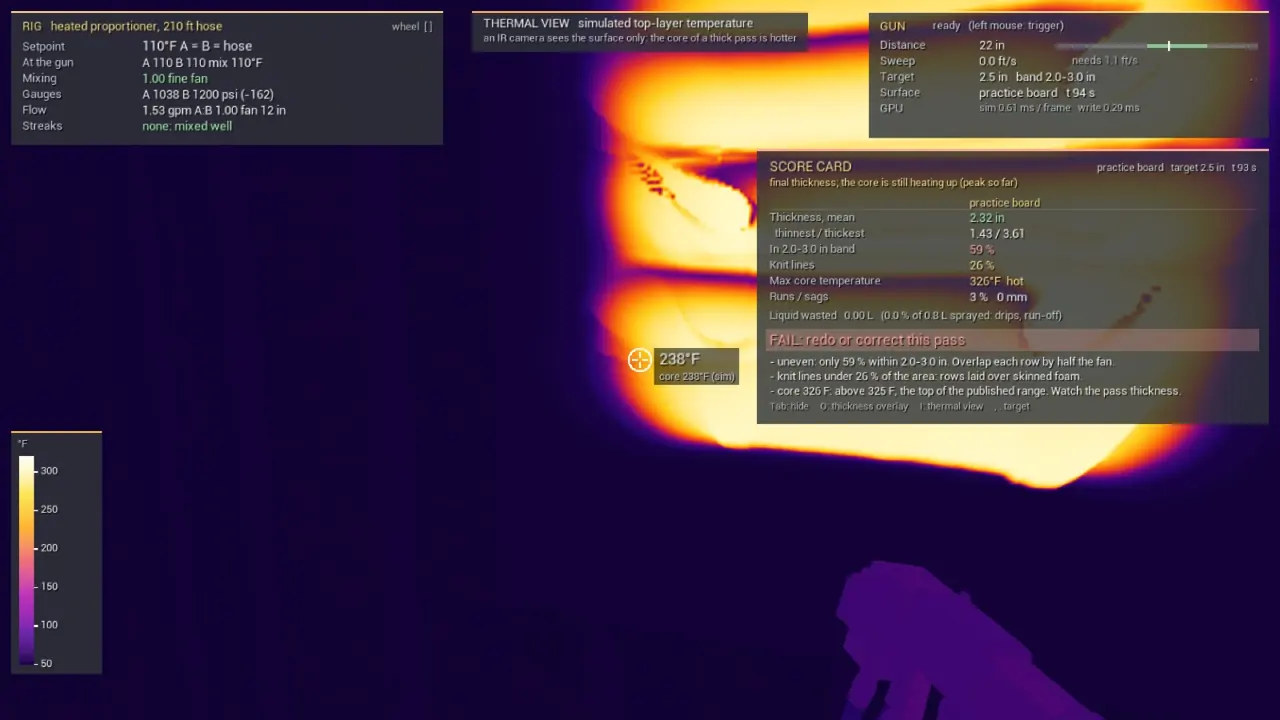
  • Overlays: thickness overlay (under / in band / over, with contour lines) and thermal view (simulated top-layer temperature in an infrared palette with a spot meter).
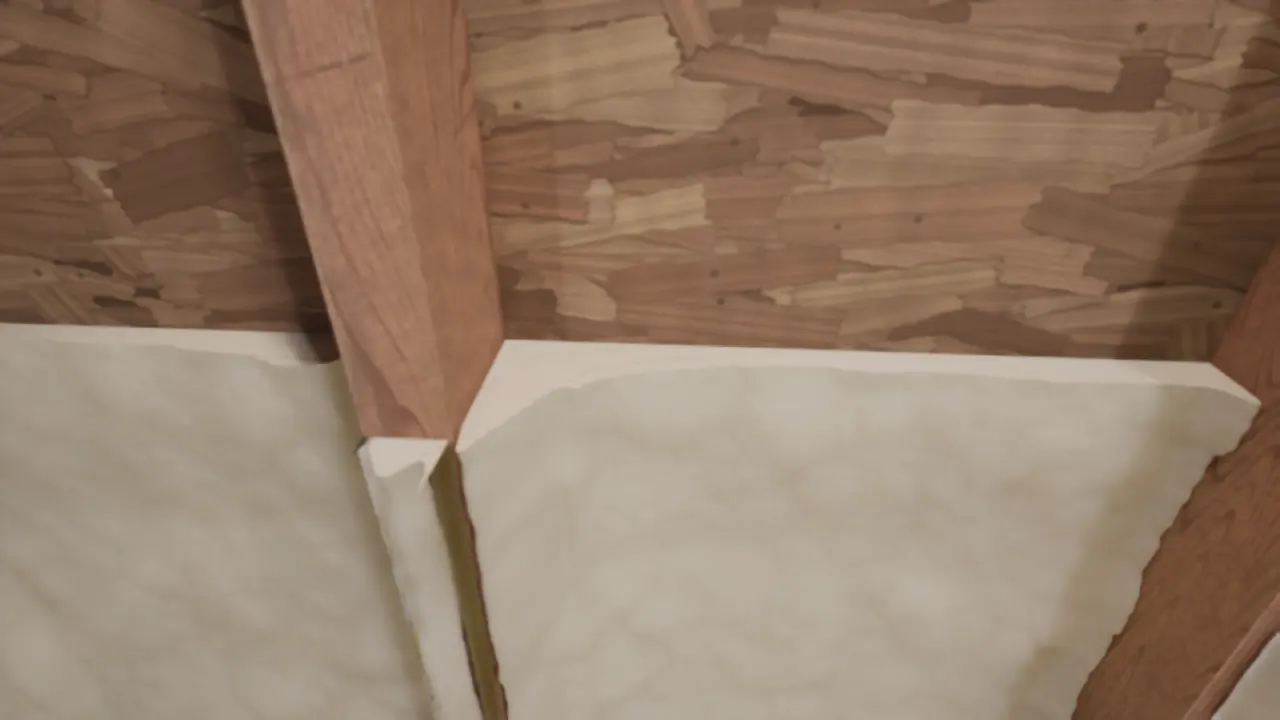
  • Cut view: slice the foam and see knit lines between passes, thick fillets versus thin corners.
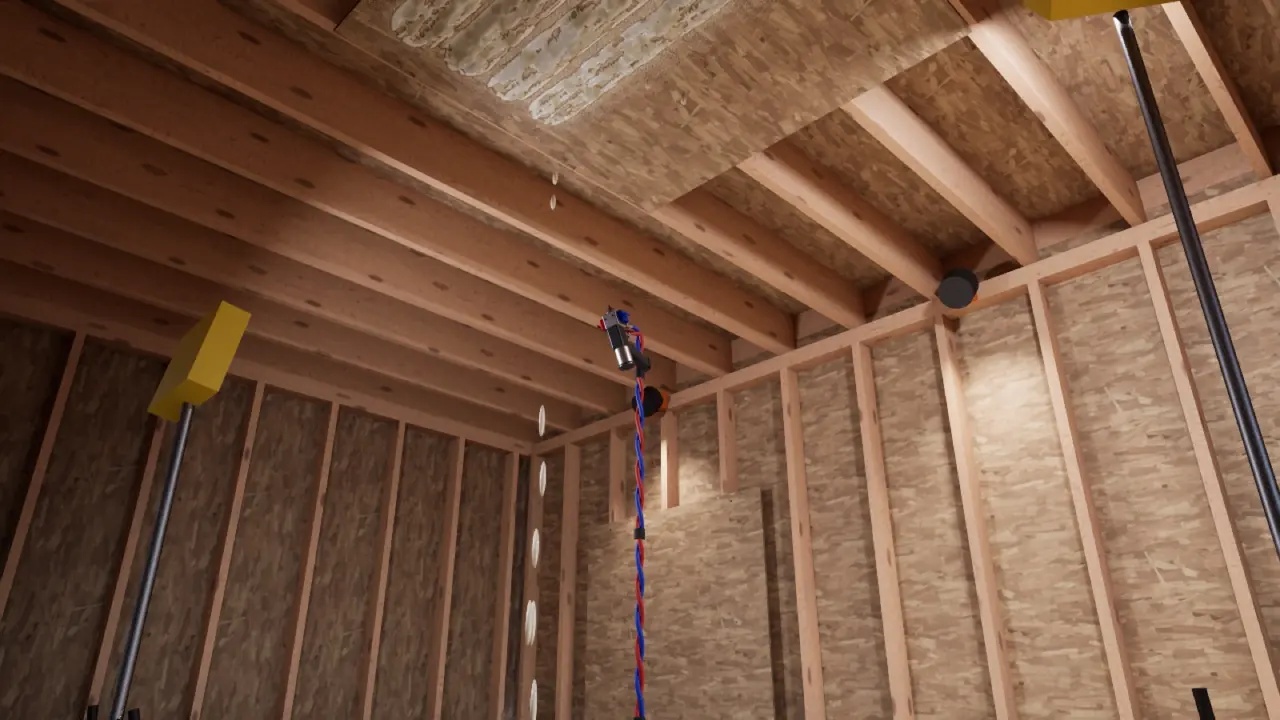
  • Live drips on ceilings; runs and sags on walls.
View // Thickness overlayCapture
Thickness overlay: under / in band / over the target, with contour lines. Real-time simulation capture.
View // ThermalCapture
Thermal view: simulated top-layer temperature in an infrared palette, with a spot meter and the score card showing a failed pass. Real-time simulation capture.
View // CutCapture
Cut view: a slice through foam in the stud bays. Real-time simulation capture.
View // CeilingCapture
Ceiling pass with drips falling. Real-time simulation capture.
// Score card

After each pass, the score card

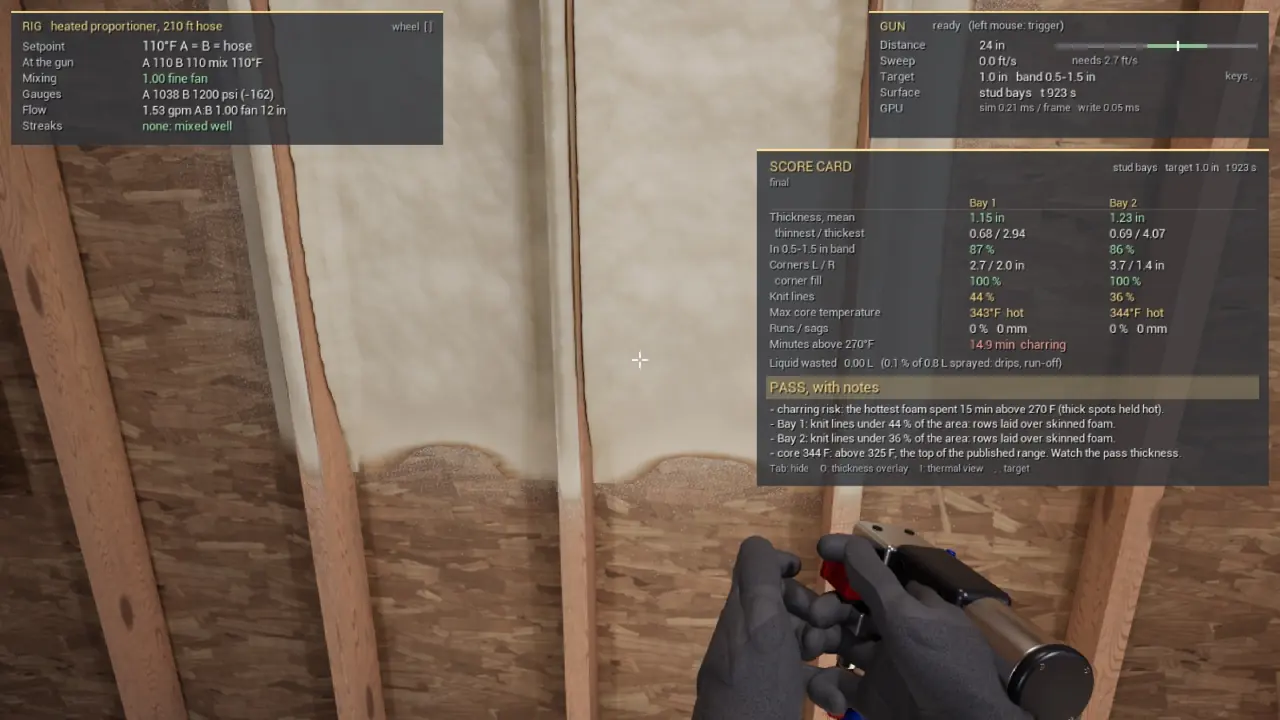
Mean, thinnest and thickest thickness; share of the area in band; corner fill left and right; knit lines; max core temperature and minutes above the hot line; runs and sags; off-ratio streaks; drips; liquid wasted.

It ends with PASS, PASS with notes, or FAIL: redo or correct this pass, with plain-language notes such as "uneven: overlap each row by half the fan", "knit lines: rows laid over skinned foam", "core above 325 F, the top of the published range".
Score cardCapture
Score card for two stud bays. Real-time simulation capture.

Development build: primitive props, gun and rig.

// In the headset

In the headset

FoamLabVR — in testing.

  • A native VR build for a PC-driven headset (Meta Quest over Link), not a cut-down headset-only version.
  • The gun in your hand: trigger sprays, haptic buzz while spraying, set the gun down and pick it up, pick up the hose; walk the bay with the thumbstick or room-scale tracking (keyboard works for a trainee with no room).
  • A menu tablet in your left hand with pages for Rig, Gun, Chambers, View, Score and Setup; a parts bench where you put a mix chamber into the gun and watch a pro pass; the score card after every pass.
  • Mark a spot, add a note and record a voice note to send to the lab (a feedback tool used in testing).
  • Tuned for VR frame rates on a gaming-class PC: fixed pixel budget per eye, adaptive resolution, a precompiled shader cache so sprays do not stall. On a gaming laptop it holds 60 to 72 frames per second until heavy foam on a full wall; that is demanding, and the lab is making it cheaper with each build.

In development

Wet-substrate spraying in the bay (moisture is in the model, not yet in the training bay)Controller-free hand tracking (not working yet)A rounder wall-run shape for a gun held on one spotCorners

Also on a flat screen

The desktop version plays with keyboard and mouse (walk the bay, spray, score) so the same training works at a desk or a trade show without a headset.

// FAQ

FAQ

Is it available now?

No. In development; limited testing builds.

Does it run on a headset by itself?

No, PC-driven VR for quality; a flat-screen version also exists.

Is the chemistry real?

The model is built from drum-level chemistry and checked against published laboratory foams, with one spot check on sprayed foam; limits are listed above. The live simulator runs on tables computed from it.

Who is it for?

Applicators, crew leads and the companies that train and equip them.

Can my product be modelled?

Tell us the system and rig in the form; we calibrate from technical data sheets.

Where do my details go?

Your details go to the SprayFoam IT team and are not shared with other companies.

// Contact

Contact